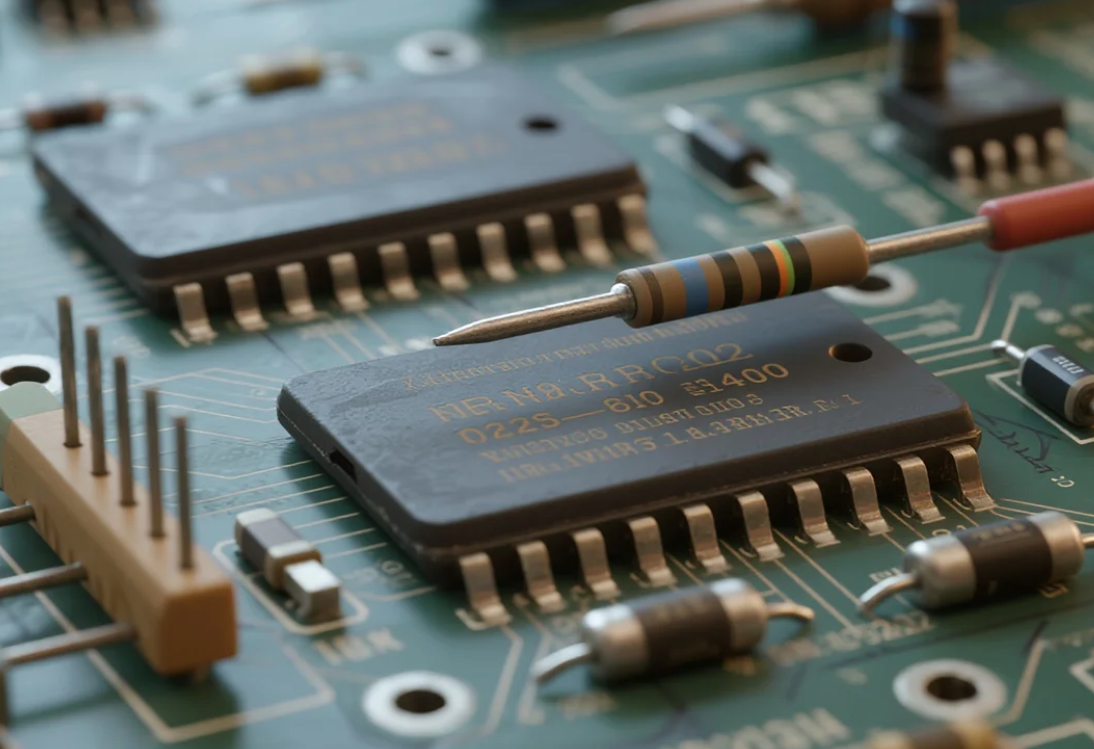
The replaceability of electronic components refers to the use of electronic components of other brands, models and specifications of the same type to replace the original ones without altering the circuit functions, electrical performance, mechanical installation structure, reliability and service life of electronic equipment. After replacement, the complete equipment can operate normally and stably, with no need to modify the PCB layout, circuit programs, peripheral supporting parameters and production processes. Component replacement is a commonly adopted technical method in R&D and maintenance of electronic products, mass production cost reduction, out-of-stock substitution and localization replacement. However, similarity in appearance alone cannot support direct replacement. It must meet strict matching standards in multiple dimensions including electrical parameters, physical structure, environmental adaptability, reliability, process compatibility and compliance certification. Failure to meet any of the standards will lead to circuit malfunction, component burnout, complete equipment failure and even potential safety hazards.
First of all, the matching of core electrical parameters is the fundamental prerequisite for component replacement. Different types of electronic components have their own key characteristic parameters, and the general principle is that the key rated parameters of the alternative component shall not be lower than those of the original one, with sufficient safety margin reserved for limit parameters. For passive components, the replacement of resistors requires consistent resistance tolerance, rated power, temperature drift coefficient and withstand voltage value. Ordinary carbon film resistors cannot substitute metal film resistors in high-precision instrument circuits. Capacitors must be matched in capacitance value, withstand voltage, temperature characteristics and dielectric type; electrolytic capacitors are not allowed to replace ceramic capacitors in high-frequency circuits. For semiconductor devices such as diodes and triodes, forward voltage drop, reverse withstand voltage, maximum operating current, switching frequency and amplification factor range must be consistent. MOSFETs and IGBTs need identical on-resistance, gate threshold voltage, withstand voltage, maximum power dissipation and switching response speed. Insufficient key parameters will easily cause thermal breakdown and out-of-control switching. For functional devices such as integrated circuits, operational amplifiers and power management chips, pin definition, operating voltage range, input and output impedance, bandwidth, response rate and logic level standards must be fully compatible with identical functional architecture; otherwise, problems such as signal distortion, abnormal driving and failure of equipment startup will occur.
Secondly, physical packaging and mechanical structure must be fully compatible. The alternative component shall have the same package size, pin quantity, pin pitch and pin arrangement as the original device. For through-hole components, pin thickness and length shall be matched; for SMD components, length, width, thickness and pad size shall fully adapt to the PCB pads without board modification, flying wiring or shell grinding. Meanwhile, the mounting and fixing method, buckle position, screw hole spacing and heat dissipation base specification shall be compatible. For power devices, the size of heat dissipation package and thermal contact surface must be consistent to avoid assembly interference, poor heat dissipation and installation mismatch. Even if the electrical parameters are completely matched, inconsistent packaging and pin definition make direct soldering and mass production impossible, depriving the replacement of practical significance.
Thirdly, adaptability to operating environment and working conditions must reach qualified standards. The operating temperature range, storage temperature, moisture and heat resistance, shock and vibration resistance, dustproof and anti-corrosion grade of alternative components shall be equivalent to or superior to those of the original parts. Commercial-grade components shall never replace industrial-grade, vehicle-grade and military-grade components arbitrarily. Commercial-grade parts feature narrow temperature tolerance and weak anti-interference ability, and are prone to failure in outdoor, vehicle-mounted and industrial control environments with extreme high and low temperatures. In addition, it is necessary to match the electromagnetic compatibility of the complete equipment. Components applied in high-frequency, radio frequency and communication circuits must maintain consistent impedance matching and parasitic capacitance and inductance parameters. Replacement shall not cause electromagnetic interference, signal attenuation or resonance offset.
Fourthly, the reliability and service life shall remain at the same level. The material, manufacturing process, aging characteristics, mean time between failures, resistance to power-on and power-off impact, and surge withstand capability of alternative components shall be similar to the original ones. Factors such as the service life of electrolyte in electrolytic capacitors, ripple resistance of solid capacitors, contact switching times of relays and plugging service life of connectors must conform to the original model. Low-cost inferior alternative materials may work normally in the short term but will suffer accelerated aging, electric leakage and poor contact in the long run, greatly reducing the service life and stability of the complete electronic equipment.
Fifthly, compatibility with production processes and assembly soldering is essential. SMD components shall adapt to the reflow soldering and wave soldering temperature profile, with consistent peak temperature resistance, soldering duration and moisture sensitivity level, so as to prevent bulging, cracking and cold solder joints during soldering. The terminal material and solderability of components shall be compatible with existing production processes without adjusting soldering temperature and time or increasing working procedures and defect rate. Meanwhile, the packaging form, tape specification and reel quantity of alternative materials shall adapt to automatic placement machines to meet the demands of automated mass production.
Finally, industry certification, safety standard compliance and supply compatibility must be guaranteed. Electronic components applied in household appliances, industrial control, vehicle electronics and medical equipment must possess equivalent safety certifications, RoHS environmental protection certification, UL, CE, AEC-Q100 automotive-grade and other qualifications. Lack of relevant certifications for alternative components will result in non-compliance of finished products and failure of market access. In addition, it is necessary to take into account the supply cycle, mass production stability and price range of materials to realize long-term stable replacement, avoid supply interruption after temporary substitution, and meet the long-term demands of product mass production, equipment maintenance and domestic substitution.
In conclusion, the replaceability of electronic components is a comprehensive matching standard covering electrical performance, mechanical structure, environmental adaptability, reliability, production technology and regulatory compliance. Only when all relevant conditions are fully satisfied can lossless and safe component replacement be realized, ensuring the performance stability and production compliance of electronic products.